
Overall project aims: Promoting the Baltic coast area as multi-modal transport corridor, with special regard to including Belarus, Western Russia and Northern Ukraine, strengthening economic and political cooperation in the region, developing the region in its role as sustainable hinterland hub, intensifying an environmentally friendly and economically benefical modal shift.
Project partnership: 1 lead partner plus 12 to max 15 partners
Project Funding: Preliminary budget: € 1.5 million
Schedule: Project duration of 36 months
Partners: Hamburg State Ministry of Economic and Labour Affairs (BWA), Lubeck Business Development Corporation, Ferryport Sassnitz, Port of Gdansk Authority, Elblag Sea Port Authority, Klaipeda State Seaport Authority, Port of Tallinn (on request), Freeport of Riga Authority, Port of Copenhagen, Port of Gaevle, Port of Koege (on request), Ministry of Transport and Communications of Belarus, ROSMORPORT Kaliningrad Branch (associated), Luzk Regional Administration (associated) (Img. 1)
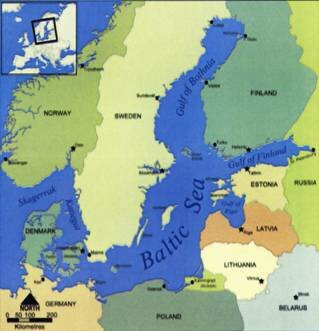
The partnership has to be seen as core partnership of official partners being supported by relevant associated and supporting partners:
Associated partners: Russian partner(s) (ROSMORPORT, Government of Kaliningrad Region), Luzk Regional Administration (Ukraine), Customs authorities of different states, private railway and logistics companies / multi-modal operator, Klaipeda Shipping Research Center.
The project will be officially supported by the Baltic Sea States Subregional Co-operation (BSSSC). Close cooperation of policy level (e.g. Transport Ministries), administrative structures (e.g. Port Authoritis, customs), commercial entities (e.g. private multi-modal transport operators), supported by BSSSC as subregional cooperation unit.
PROJECT BACKGROUND
Thematic Priorities of the programme
- Fostering Innovations across the Baltic Sea Region
- External and Internal accessibility of the Baltic Sea Region
- Management of the Baltic Sea a a common resource
- Promoting attractive and competitive cities and regions
Priority 2 aims at improving external and internal accessibility of the Baltic Sea Region, highlighting the promotion and preparation of joint transnational solutions in the field of transport.
PROJECT STRUCTURE
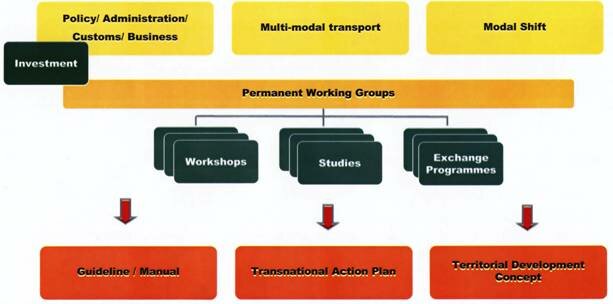
Work Component 1: Management and Coordination
Work Component 2: Communication and Dissemination
Work Component 3: Policy/ Administration/ Customs/ Business
Work Component 4: Multi-modal transport incl. EDI
Work Component 5: Modal Shift incl. inland waterways, dry ports,
regional development
Thematic Work Components (Img. 2)
EXPECTED BENEFITS AND RESULTS
- Improved competence and cooperation of administration and associations involved in multi-modal transport and upgrade of their knowledge on transnational hindrances for efficient transport (incl. Customs) and how to overcome them
- More well-informed private companies through appropriate tools (workshops, webpage, etc.) dealing with latest development in EU/ Russian-Belarus transport flows as well as import/ export procedures
- Improved internal and external accessibility for goods to the Baltic Sea region and its natural hinterland
- Raising awareness of and investing in efficient and environmentally friendly transport modes
- Permanent interaction and communication with related bodies
- Encouraging enterprises to explore foreign markets through seminars and publications
- Dissemination of project results to a wider BSR transport community
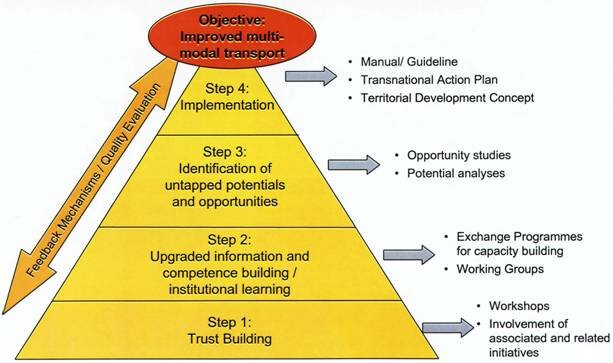
Improved multi modal transport (рис. 3)
Natalia Kapustina (BNTU, Belarus), Michael Stange (Free and Hanseatic City of Hamburg State Ministry for Economic and Labour Affairs European Affaire Section)