The international seminar Belarusian Diaspora: Past and Present organized by the Foreign policy and security (FPS) research center took place in Minsk on September 20, 2010. Dr. Renee Buhr (on the first photo) from the University of St. Thomas, Minnesota, USA took part in the seminar.
Dr. Viktor Shadurski, the dean of the Faculty of International Relations (BSU, Minsk), Doctor of History, Professor of International Relations introduced the participants and informed about their research, emphasizing the importance of studying the history and present of the Belarusian communities abroad both for the academic sector and civil society. He informed that the Ministry of Education of Belarus had ordered the writing of a schoolbook on the Belarusian communities abroad and the Faculty of International Relations is working on it now.
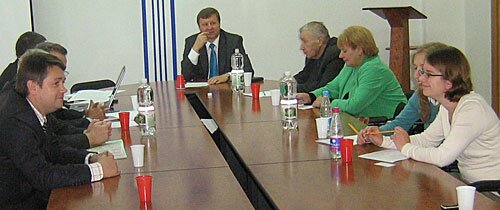
Mr. Sergei Palagin, the Director of the FPS, expressed his conviction that civil society of Belarus is interested in establishing and developing contacts with compatriots living outside Belarus. He also drew attention to the fact that foreign researchers sometimes lack the objective scientific information without political overtones about Belarusian diaspora: they often use either publications from the official sources, or the information from individuals acting in opposition to the Belarusian Government. The Director of the FPS called for foreign scientists to expand cooperation with the academic community of the Republic of Belarus.
Ms. Halina Nowitskaya, the representative of the Belarusian NGO "Radzima" ("Motherland") informed that her association is prepared to provide assistance in establishing contacts with Belarusian diasporas abroad to the scientific community in Belarus and other countries, to supply archival material, if nessecary.
Mr. Alexander Tikhomirov, Associate Professor of International Relations, Faculty of International Relations, (BSU, Minsk), told about the history of the Belarusian communities abroad from 11th century. The scientist provided information on the migration trends of ethnic Belarusians.
Mr. Andrei Rusakovich, Associate Professor of International Relations, Faculty of International Relations, (BSU, Minsk), gave a presentation on the Belarusian diaspora in Western Europe.
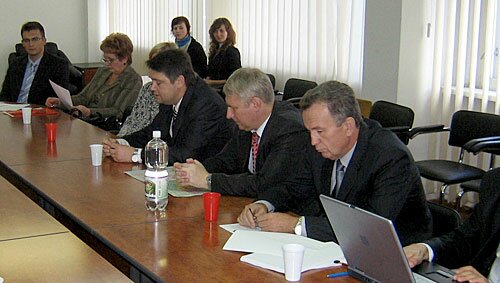
Mr. Konstantin Andrievsky, Ph.D. candidate, Faculty of International Relations, (BSU, Minsk), drew attention to the Belarusian diaspora in Latin America and the United States. He noted that during World War II, Nazi occupiers sought to actively use the Belarusians at the territory of the USSR. After the war some top-ranked Belarusian collaborators managed to go to live in the U.S., where they were organically involved in advocacy work of Washington against the Moskow during the Cold War.
Dr. Renee Buhr, Ph.D, Assistant Professor, Department of Political Science, (University of Saint Thomas, U.S.A.), reported that the current program of study of the Belarusian diaspora in the U.S. is still being under development, U.S. scientists are exploring the literature and preparing a program of interviews.
At the seminar they discussed the establishment of the Research Center for the Study of the Belarusian diaspora in the U.S. under the auspices of the University of St. Thomas. Activities under this Research Center could be carried out in close cooperation with Belarusian scientists.

