- Home
- About
-
Staff
- Commentaries by FPS Staff
- Rusakovich Andrei Vladimirovich
- Rozanov Anatoliy Arkadievich
- Research Briefs
- Tihomirov Alexander Valentinovich
- Shadurski Victor Gennadievich
- Sidorchuk Valery Kirillovich
- Brovka Gennady Mikhailovich
- Gancherenok Igor Ivanovich
- Malevich Ulianna Igorevna
- Prannik Tatiana Alexandrovna
- Selivanov Andrey Vladimirovich
- Sharapo Alexander Victorovich
- Testimonials
-
Conference Proceedings
- Amber Coast Transport Initiative Project Concept
- Nato and Belarus - partnership, past tensions and future possibilities
- OSCE High-Level Seminar on Military Doctrine
- Poland-Belarus: perspectives of cross-border cooperation
- Polish-Belarussian Transborder Customs Cooperation: сurrent Problems and Challenges
-
Reports
- We see the significant reduction of the U.S. Army in Europe
- NATO's International Security Role
- International seminar on issues in the Collective Security Treaty Organization
- Belarus-Turkey: The ways of cooperation - 2011
- Belarus - Poland: two decades of international relations
- Belarus-Turkey: The ways of cooperation - 2009
- International seminar Belarusian Diaspora: Past and Present
- The first Round Table
-
News Releases
- The conference on Overcoming the financial crisis
- Round Table on history and future of Belarus-Poland cooperation
- Seminar on Belarusian diaspora: past and present
- The conference on Belarus in the Modern World
- The conference on Economic, legal and informational aspects of cooperation in customs sphere
- Comments
- Contact



Belarusian government-controlled newspapers attract a far larger readership than "so-called independent" publications, Information Minister Aleh Pralyaskowski claimed during a live online questions-and-answers session on August 23, BelaPAN said.
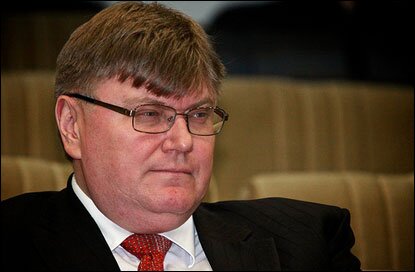
"Our publications have much higher ratings than so-called opposition papers, while the numbers of their subscribers cannot be even compared," he added.
"Moreover, our publications are capable of starting to pay their way amid difficult economic times," he said, adding, however, that the authorities continued funding such newspapers.
Commenting on the government's practice of requiring organizations and companies to subscribe to state newspapers and magazines, he claimed that they were free to refuse to do so. "But I see nothing wrong with papers and magazines being present in a company's office, workshop. This is not at all bad, in my view," Mr. Pralyaskowski said.
The minister also dismissed as the "opposition's fantasy" complaints that newspapers critical of the government experienced distribution problems and were denied information by government officials and institutions.
According to Mr. Pralyaskowski, there are almost 2,000 print media outlets and some 90 news sites in Belarus.
He acknowledged that some state newspapers painted a too rosy picture of the situation in the country but noted that Sovetskaya Belorussiya, the largest government-controlled newspaper, ran enough critical stories.
The minister also said that pro-opposition media were biased and sought to portray the situation in Belarus only in a negative light.
